Saturday, October 4, 2014

Why Pediatricians Are Prescribing Books

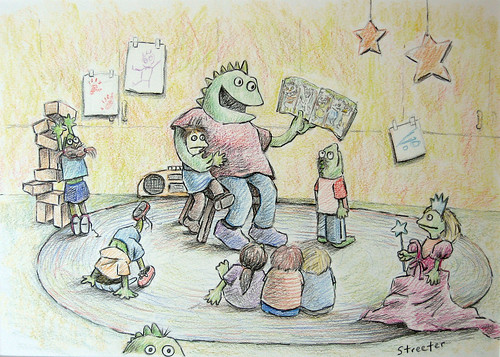
3575700933_2296c573eb
betsystreeter via Compfight cc

Earlier this week, the American Academy of Pediatrics issued a policy statement recommending that story time with mom and dad start in infancy: parents should be reading to their children, the group says, from the first days of their lives.
Research shows that one-third of American children start kindergarten lacking the basic language skills they will need in order to learn to read, a deficit that can ripple through all the years of schooling to follow. Reading aloud is one of the best ways to build such skills, but surveys find that only about half of low-income parents in the U.S. are reading to their children every day. Scientists have repeatedly demonstrated that better-educated people live longer and have a lower risk of disease than their less-educated counterparts. It makes perfect sense, then, that many pediatricians are adding a new tool to their doctors’ kits: books.
There are hurdles, however, in the way of many parents taking this advice: they may not themselves be literate, for example. A study released earlier this month by the Stanford University School of Medicine reported that immigrant parents and parents with low education levels or low household incomes were less likely to read to their children. In addition, poor families may not have access to books. One study found that in low-income neighborhoods, only one book was available for every 300 children, while in middle-income neighborhoods the ratio was 13 books for each individual child. And many parents may know that they should be reading to their children each day, but find that work schedules and other household activities get in the way.
Pediatricians make ideal conduits for the message that reading is important. Ninety-six percent of children under five years old see their doctor at least once a year, and the opinion of a physician often carries more weight with parents than that of a teacher or counselor. Taking advantage of this privileged position, a growing number of pediatricians are “prescribing” books to their young patients at each visit (some of them even write out the directive to read on a prescribing pad).
Many are doing so under the auspices of an organization called Reach Out and Read, which was founded in 1989 by a group of doctors at Boston City Hospital (now called Boston Medical Center). Over the past 25 years, Reach Out and Read has trained thousands of primary care providers to speak with patients about the benefits of reading. They have distributed millions of books through these medical partners. Each enrolled child gets a new, age-appropriate book at every well-child visit, from six months to five years of age. That means they’ll start kindergarten with a home library of as many as 10 books—and these are often the only children’s books they own.
When working with parents who are unable to read themselves, doctors in the Reach Out and Read program demonstrate how they can page through a picture book with their children, making up their own stories as they go. And when counseling parents who say they’re too busy or too tired to engage in story time at the end of the day, some physicians read aloud a book to their young patients right in the consulting room, to demonstrate to parents how quickly book reading can be accomplished and how much their children enjoy it.
In another literacy-promoting program, developmental specialists at the Langone Medical Center at New York University actually videotape parents reading to and playing with their children; then the parents and the specialist watch the video together, a practice that encourages parental self-reflection and self-improvement.
Researchers who have evaluated the effects of Reach Out and Read report that participating parents are up to four times more likely to read to their young children, and that their children enter kindergarten with larger vocabularies and stronger language skills. Interestingly, families who participate in Reach Out and Read are also more likely to show up for their doctors’ appointments: yet another way that health and learning can work together. 
http://time.com/2934047/why-pediatricians-are-prescribing-books/?utm_source=Brilliant%3A+The+New+Science+of+Smart+Newsletter&utm_campaign=7c4bff878a-Brilliant_Report_16_1_2012&utm_medium=email&utm_term=0_9c734401c1-7c4bff878a-311798661 

Friday, October 3, 2014

An Ancient Way to Heal The Mind Finds New Scientific Support

Post image for An Ancient Way to Heal The Mind Finds New Scientific Support
The benefits were particularly strong for those who were stressed.
Taking group walks in nature is associated with better mental well-being and lower stress and depression, a new large-scale study finds.
The study is one of the first to show that simply walking in nature doesn’t just benefit the body, but also the mind.
Sara Warber, one of the study’s authors, said:
“We hear people say they feel better after a walk or going outside but there haven’t been many studies of this large size to support the conclusion that these behaviors actually improve your mental health and well-being.”
The study evaluated a British program called ‘Walking for Health’ and it involved nearly 2,000 participants (Marselle et al., 2014).
Two matched groups of people were compared: some who took part in the group nature walks, and others who did not.
Over a three-month period, taking part in the group nature walks was associated with less depression, lower perceived stress and higher mood and mental wellbeing.
Those who seemed to see the most benefit were those who had been through a recent stressful life event, such as divorce, bereavement or a serious illness.
Warber continued:
“Walking is an inexpensive, low risk and accessible form of exercise and it turns out that combined with nature and group settings, it may be a very powerful, under-utilized stress buster.
Our findings suggest that something as simple as joining an outdoor walking group may not only improve someone’s daily positive emotions but may also contribute a non-pharmacological approach to serious conditions like depression.”
Walking in nature seems to be one of the keys to getting the most mental benefit; urban environments do not provide the same boost.
Much modern research is starting to pick up on the importance of the natural environment for our mental health.
For example, the Japanese are big fans of walking in the forest to promote their mental health.
The practice is called shinrin-yoku, which literally means ‘forest bathing’.
One study conducted by Japanese researchers has found that the practice is particularly useful for those suffering acute stress (Morita et al., 2006).
Their study of 498 people found that shinrin-yoku reduced hostility and depression as well as increasing people’s liveliness compared to comparable control groups.


Thursday, October 2, 2014

20 Wonderful Effects Exercise Has on the Mind


Post image for 20 Wonderful Effects Exercise Has on the Mind


Studies find exercise increases stress resilience, fights anxiety, speeds up the mind, protects against dementia, is more fun than we predict, and more…
If everyone got a little exercise, we could put half the doctors in the world out of a job. But it’s not just doctors who’d be out of a job if people could take the stairs every now and then, it’s also psychologists. Here are 20 wonderful psychological effects that exercise has on the mind.


1.      Increases stress resilience
Studies on mice have shown that exercise reorganises the brain so that it is more resistant to stress (Schoenfeld et al., 2013).
It does this by stopping the neurons firing in the regions of the brain thought to be important in the stress response (the ventral hippocampus).
This may be part of the reason that exercise…
2. Reduces anxiety
Exercise has a relatively long-lasting protective effect against anxiety (Smith, 2013).
Both low and medium intensity exercise has been shown to reduce anxiety. However, those doing high intensity exercise are likely to experience the greatest reduction in anxiety, especially among women (Cox et al., 2004).
3. Lower dementia risk
Almost any type of exercise that gets your heart working reduces the risk of dementia.
A review of 130 different studies found that exercise helped prevent dementia and mild cognitive impairment among participants (Ahlskog et al., 2011). Regular exercise in midlife was associated with lower levels of cognitive problems.
Not only this, but participants who exercised had better spatial memory.
4. Escape a bad mood
If you want to raise your energy levels, reduce tension and boost mood, you can talk to your friends or listen to some music.
But most agree that for the difficult job of transforming a bad mood into a good one, exercise is the most effective method (Thayer et al., 1994).
5. Cut down on cocaine
Or perhaps you’re getting a little too happy?
By all accounts, cocaine is a bit more-ish. At least when you put it into the water of experimental rats, they suddenly develop quite a thirst.
Exercising rats, though, while still enjoying a little taste of Columbia, tend to self-administer less cocaine (Lynch et al., 2010). This suggests exercise may help humans regulate their cocaine intake.
6. Fight depression
Just as exercise fights anxiety, it also fights its close relation, depression.
One review of 39 different studies involving 2,326 people has found that exercise generally provides moderate relief from depression (Cooney et al., 2013).
It won’t cure, but it can certainly help. The effects may be as great as starting therapy or taking anti-depressants.
7. Speed up your mind
Working memory includes what’s in your conscious mind right nowand whatever you’re doing with this information.
After 30 minutes exercise, people’s working memory improves. There’s some evidence that accuracy drops a bit, but this is more than made up for by increases in speed (McMorris et al., 2011).
8. Consolidate long-term memory
The effects of exercise on long-term memory are somewhat controversial.
However, at low-intensity, one recent study has found that exercise can benefit long-term memory (Schmidt-Kassow et al., 2013; see: Exercise Can Improve Long-Term Memory).
9. Boost self-control
A review of 24 different studies on the effects of exercise on self-control, found that a short bout provides an immediate boost to self-control (Verburgh et al., 2013).
Although regular exercise didn’t show an effect on self-control, a period of moderate exercise did allow people to take better control of themselves.
10. Help with serious mental disorders
Schizophrenia is a serious mental disorder often involving hallucinations, paranoia and confused thinking.
Despite its grave nature, there’s evidence that exercise can help for this, as well as alcoholism and body image disorder (Tkachuk et al., 1999).
11. Reduce silent strokes
A silent stroke is one that seems to have no outward symptoms, but does actually damage the brain.
Without knowing why, sufferers can start experiencing more falls, memory problems and difficulties moving.
Exercise, though, reduces the chance of these silent strokes by 40%.
It has to be more than just walking or playing golf, though; things like jogging, biking, playing tennis or swimming are probably required to get the protective effect (Willey et al., 2011).
12. Alzheimer’s protection
In the most common form of dementia, Alzheimer’s, the brain literally wastes away; closely followed by the body.
Neurons and synapses are lost and the sufferer’s memory, personality and whole being slowly but surely disappear.
Exercise, though, provides a protective effect against Alzheimer’s by helping to produce chemicals which fight the damaging inflammation of the brain (Funk et al., 2011).
13. Improve children’s school performance
Children who are fitter and engage in more exercise do better at school (Tomporowski et al., 2011).
Incredibly, one study has found that the increased mental abilities of children who exercise makes them safer crossing the road when distracted by their mobile phones (Chaddock et al., 2012).
There’s a reason to get kids to exercise if ever I heard one.
14. Stimulate brain cell growth
Part of the reason that exercise is beneficial in so many different mental areas is that it helps new brain cells to grow.
A study on rats has shown that, in response to exercise, the brain regions related to memory and learning grow (Bjørnebekk, 2007).
15. Increase executive functioning
What psychologists call ‘executive functioning’ includes all kinds of useful abilities like being able to switch tasks efficiently, ignore distractions, make plans, and so on.
Reviewing many studies in this area, Guiney and Machado (2012) find that exercise reliably improve executive function, especially in older adults.
16. Better sleep
The relationship between exercise and sleep is a little more complicated than most imagine. It’s not necessarily the case that exercise makes you tired, so you sleep better.
For example, one study on insomniacs found that 45 minutes on a treadmill did not make them sleep better that night (Baron et al., 2013).
However, the study found that exercise did help sleep in the long-term. Participants with insomnia who kept to their exercise programs over 16 weeks did get better sleep than those who did no exercise.
17. Prevent migraines
Migraine sufferers are often afraid of exercise because it might bring on an attack.
But a study has shown that exercise can actually help prevent migraines (Varkey et al., 2011).
Participants who took part in three sessions a week on an exercise bike for three months showed improvements equivalent to taking the latest anti-migraine drugs.
18. Stop smoking
Even something as simple as a short walk can help people give up smoking.
According to 12 different studies reviewed by Taylor et al., (2008), people who take a brisk walk, or similar exercise, experience less stress, less anxiety and fewer withdrawal symptoms when trying to give up.
The reason it helps is partly because it actually makes the cigarettes seem less attractive (Van Rebsburg et al., 2009).
19. Reduce motivation to eat
People tend to think that exercising makes you eat more to replace the lost calories, but new research questions this.
Recent studies have found that, after exercise, people show lower motivation to eat food (Hanlon et al., 2012).
Exercise may suppress appetite by decreasing the body’s levels of ghrelin, which is a hormone that stimulates appetite (Broom et al, 2008).
20. It’s more fun than we predict
The final effect exercise has on the mind is not so wonderful. It’s the effect that we tend to predict it’s going to be horrible.
But this is short-sighted. Research has shown that while exercising can be a drag at the start of the session, people soon warm up.
According to Ruby et al. (2011), people enjoy their workouts much more than they predict. This was true across lots of different types of people and for both moderate and challenging workouts (see: Why Exercise is More Fun Than We Predict).
So, give it a go, it really won’t be as bad as you think. You might even enjoy it.

3/10/20-wonderful-effects-exercise-has-on-the-mind.php

Saturday, September 27, 2014

What's wrong with school lunches in most schools


Thank you the PTO Canteen Committee and Global Cafe for the work you have achieved in our cafeteria at ISHCMC


Friday, September 26, 2014

The six paths of the typical US college graduate—and why they’re all wrong


chrisjohnbeckett via Compfight cc

"There are currently six prominent paths for achievement-minded recent college graduates: financial services, management consulting, law school (still), med school, and grad school/academia.  The sixth is Teach for America, which continues to draw approximately 5,000 graduates (and 50,000 applicants) a year from universities across the country.

Here are the stats from national universities over the last several years:


If you add up the numbers, you’ll see that these six paths account for between 50-70% of top university graduates in the US. Relatedly, the top destinations for graduates from these schools are New York City, San Francisco, D.C., Boston, Chicago and L.A., all of which are hubs for professional services. At my organization, we sometimes joke that smart people are doing six things in six places.  If the strength of our economy and society was determined by the academic excellence of our coastal professional service providers, we’d be in great shape.

Why is our talent so concentrated? Former Yale professor Bill Deresiewicz recently published a book, Excellent Sheep, which argues that elite college students are being trained to advance and compete with little regard for higher concerns. In my mind, it’s in large part a question of access and resources.  The banks and consulting firms have massive recruitment budgets and spend millions a year seeding and building talent pipelines (as does Teach for America). Law school, med school, and graduate school are very easy and obvious to access and apply to. How much would the brand “Harvard Law School” be worth if it belonged a private company? Plus, the government will provide you tens of thousands of dollars in education loans to attend professional school if you get in. (I know this from personal experience—I attended law school and borrowed over $100k no questions asked, signing various forms when I was 21.) Meanwhile, Businessweek projects 176,000 unemployed or underemployed law school graduates by 2020 and the unemployment rate among PhDs is as high as 40%."
http://qz.com/271422/the-six-paths-of-the-typical-us-college-graduate-and-why-theyre-all-wrong/

Wednesday, September 24, 2014

Why students should take the lead in parent teacher conferences.

A particularly vivid example of putting students in the driver’s seat of their own education is the way they handle what traditional schools refer to as parent-teacher conferences. At these time-honored encounters, it’s not uncommon for students to stay home while the adults discuss their progress or lack thereof. But at schools built on Deeper Learning principles, the meetings are often turned into student-led conferences, with students presenting their schoolwork, while their teachers, having helped them prepare, sit across the table, or even off to the side. The triad then sits together to review and discuss the work and the student’s progress. The message, once again, is that the students are responsible for their own success.
The specific dynamics of these conferences vary widely. At California’s Impact Academy, three or four different sets of students and their families meet simultaneously, as teachers circulate through the room, making sure parents are getting their questions answered, and only intervening if the student is struggling. Yet in all cases, the basic spirit is the same: this is the student’s moment to share his or her reflections on achievements and challenges.
At King Middle School, the twice-yearly student-led conferences are “one of the most important things we do to have students own their own learning,” says Peter Hill, who helps prepare kids in his advisory class, or crew, for their meetings. “And yet, the students’ first impulse is to tear through their folders to find every best thing that they have done to show their parents.”
Instead, Hill encourages students to reflect on the connection between the effort they have made and the quality of their work. To this end, he asks them to choose three examples that help them tell their parents a deeper story: one that shows they have recognized both a personal strength and an area in which they are struggling. Most students, he says, have never thought about their learning in this way. Nor have most of their parents.
Indeed, many parents need some time to adjust to the new format, Hill acknowledges. Often, he says, a mother or father “just wants to ask me about how their child is doing, or how they are behaving. Sometimes I have to nudge the conversation back to let the child lead. We also have to teach the parents how to be reflective about their kids’ work and how best to help.”
Eventually, however, most if not all parents appreciate the new process, teachers told us. “They come to realize that report cards don’t tell them anything very useful,” says Gus Goodwin, Hill’s colleague. “And over time, the parents begin to set a higher bar for their students at these conferences.”
As crew leader, Hill has his students practice how they’ll discuss their work products with their parents. We watched as he spoke with one eighth-grade boy who initially shyly lowered his head as he confessed that he felt uncomfortable showing his work to anyone, including his mother and father. Hill told the boy he understood how he felt, and then offered some strategies for discussing his work in math, which both of them knew was a problem area. “You have done some good work of which you should be proud,” he told him. Together, they then picked out a paper that demonstrated the boy’s effort, after which Hill suggested: “When we have the conference, why don’t you use this assignment and begin by saying, ‘I have done a good job in math when I . . . .’ ” The boy wrote the phrase in his notebook, and visibly began to relax, after which Hill used the rest of the advisory period to find more examples of work that showed his effort.
As kids learn to advocate for themselves in this way, they discover how to let their parents know more specifically how to support them. Hill tells the story of one student who was clearly intelligent, but struggling with his independent reading. Rambunctious in class, the boy surprised Hill by sitting straight and quietly in his chair when his father, a seemingly stern man, walked into the room. But what surprised him even more was when the boy spoke up for himself during the conference, telling his father: “I realize now that I need to spend more time reading on my own and I need your help with that. I need my three brothers out of the room at night so I can read in silence.”
Such exchanges empower both students and their parents, Hill noted, adding: “When I checked in on the student a few weeks later, he was very pleased that his dad was keeping his brothers out of his room so he could do his silent reading.”
At Science Leadership Academy, health educator Pia Martin coaches her students in how to communicate with parents about difficult topics, such as why they might have received a C in a class. “How will your parents respond?” she asks. “What are the things that will trigger your parents and how will that play out? Will this lead to lost privileges or other forms of punishment? How do we minimize this?”
“In conference, I’m your advocate,” she always reminds them. Like Hill and several other teachers we spoke with, Martin said she usually helps begin conferences by encouraging students to talk about what they are good at, to prevent meetings from turning into blame-fests. She tells the students to start the meeting with two questions: “What do I do well?” and “How can I build on this?”
“I always tell them, ‘Own what you got,’ ” Martin says. Only after students spend a moment to recognize what they’re doing right does she encourage them to tackle the challenges, with the following questions: “What have I not done well?” and “How can I improve this?”
http://blogs.kqed.org/mindshift/2014/09/why-students-should-take-the-lead-in-parent-teacher-conferences/?utm_source=feedburner&utm_medium=email&utm_campaign=Feed%3A+kqed%2FnHAK+%28MindShift%29

Tuesday, September 23, 2014

The Difference between Praise and Feedback

864731205_67238ff62ewoodleywonderworks via Compfight cc

"Parenting these days is patrolled by the language police. Sometimes it seems like the worst thing you could ever say to a kid is “Good job!” or the dreaded, “Good girl!”  Widely popularized psychological research warns about the “inverse power of praise” and the importance of “unconditional parenting.” The incorrectly phrased, indiscriminately doled out pat on the back can, we learn, undermine a child’s inner motivation to learn and achieve, promote a “fixed mindset” that will cause her to shrink from taking on any kind of challenge or effort, and maybe even destroy her sense of self worth.
The anxiety is such that parenting blogs circulate actual word-for-word scripts for parents to use in such difficult situations as the sidelines of a swim meet, or after a music recital. There are long lists of forbidden words and phrases, too.
What are these researchers really getting at? Are the particular words we use to talk to our kids so important? And how do we convey positive feelings without negative consequences?

Process Praise

Some of the most prominent psychologists behind all of this talk about talking are Stanford University’s Carol Dweck, author of the book Mindset, and Edward Deci and Richard Ryan at the University of Rochester, whose research the education author Alfie Kohn relies heavily on in his books including Unconditional Parenting. Both Dweck and Deci are theorists of human motivation, but they emphasize very different perspectives on praise.
Dweck’s studies have focused on the effects of “process praise,” which means praising effort or strategy: “You must have worked very hard on this painting!” This is opposed to “person praise,” which labels people with phrases like, “You are really good at painting!” “You must be a genius!”
The idea is that reinforcing effort contributes to children’s beliefs that they can get better at things if they try, the vaunted “growth mindset.” But praising traits feeds the belief that talent is fixed, which makes kids less willing to take on new challenges that might expose them as less naturally able.
Most of Dweck’s research has focused on process praise given by strange adults interacting with children in a research study environment. But in a recent study, her team coded videotapes of parents praising their one to three-year-old children. They found that the greater use of process praise with these very young children predicted their later desire to take on new challenges, which in turn influenced these children’s math achievement seven years later, in fourth grade.
“Kids are thrilled by the idea that they can grow their brains through their effort and strategy,” Dweck says. “Praising strategy and focus and improvement gives them actionable information and a reason to try hard.”

Praise and Personhood

Simple, right? Not so fast. Writers such as Kohn have condemned all praise, including Dweck’s “process praise,” as little more than “sugarcoated control.”
The idea is that parental praise is manipulative, intrusive, and undermines both children’s intrinsic enjoyment of what they’re doing and their own internal sense of whether they are, in fact, doing a good job or trying hard.
Kohn cites Deci and Richard Ryan, and their colleagues including Guy Roth and Avi Assor at the University of the Negev in Israel. All of them have found in a series of studies that when parents express any kind of “conditional regard,” it harms young people’s developing autonomy, causing them to feel pressured to achieve, to feel shame if they don’t, and to suppress negative emotions and experiences. Conditional regard includes positive reinforcement, the practice of offering praise in exchange for desired behavior.
“If you tell your kids, ‘You’re a good boy for taking out the trash,’” they may feel that if they don’t take out the trash, they’re not worthy of your love,” says Deci. “You need to express that you love them and approve of them no matter what they do.”
Verbal rewards are a pretty central weapon in the parenting arsenal, especially when it comes to academic achievement. Deci and his colleagues found that offering your warmth and approval in exchange for academic achievement does work, in the sense that it causes young people to be more invested in trying to do well in school. But it’s a devil’s bargain that backfires emotionally in the form of “maladaptive self feelings.”
The controversial recent book The Triple Package, coauthored by “tiger mom” Amy Chua, purported to explain why certain ethnic groups tend to outperform others in education, occupational status and earnings. Two of the three traits the authors describe are a superiority complex accompanied by insecurity—a pretty good description of what researchers say can be the outcome of too much conditional parental positive regard.

Praise vs. Feedback

Parents are not perfectly controlled Siri-like bots but human beings with positive and negative emotions that are going to arise in response to specific actions by children. So is there any way to channel and communicate your sincere feelings to your kids without doing lasting harm? Surprisingly, despite their differing views on praise, Dweck and Deci tend to agree on the right course of action.
When I ask Dweck about the “sugarcoated control” idea, she says, “I basically agree that we overpraise.” Her intention in talking about process praise is to redirect this impulse more constructively. Instead of mindlessly kvelling over every fingerpainting or math test — or even just telling kids to “try hard!” — her recommendation is to get more involved with what a kid is doing. “Appreciate it. Ask questions. If we see that a child is using interesting strategies we can ask about them. Talk to them about their thought processes, how they can learn from mistakes.” Encourage your child to actively seek both positive and negative feedback in order to grow and improve.
Deci says something similar. In addition to assuring children of your continuous love and regard, “You want to understand what your child is thinking and feeling, to be respectful toward them. Asking questions is a far better idea than giving praise”—or criticism for that matter.  The idea is to support the development of a child’s autonomy by taking his perspective.
If you’re on the sidelines at a soccer game, it’s easy to pull out some pre-scripted phrase like “I love to watch you play!” or “You’re a natural!” It’s harder to watch your kid so you can tell her, “When you made that pass in the second quarter, I could see that you’ve been practicing your footwork a lot,” or to take the time to ask, “What was your favorite part of the game?” and really listen to the answer.
Providing helpful, detailed, encouraging feedback and appreciation requires paying attention to what kids are doing, and listening to what they are saying. This takes time and energy. Dweck says what she sees all too often are time-pressured parents who reach for a quick sugar fix instead. “We are a praise-addicted culture. I don’t think parents are going to stop praising.” "


http://blogs.kqed.org/mindshift/2014/03/the-difference-between-praise-and-feedback/